Trade paperwork,
read by a system that
cross-references itself.
An automated document processing system that reads Letters of Credit (bank guarantees for trade payments), Bills of Lading (shipping receipts), and commercial invoices then cross-checks them against each other to ensure complete accuracy.
What is ICS Compute Trade Documents Processing?
ICS Compute Trade Documents Processing is an AI-assisted document processing system designed for trade finance operations.
It reads and extracts information from Letters of Credit, Bills of Lading, commercial invoices, and related trade documents, then cross-checks key fields across documents to identify missing information, inconsistencies, and potential mismatches.
The system combines automated document processing with confidence scoring, traceable reasoning, and human review for uncertain cases, allowing trade officers to focus on exceptions rather than manually checking every field.
Unstructured documents,
structured financial risk.
Every trade finance application starts with a stack of PDFs, scans, and forms that don't talk to each other. Officers spend hours matching Letters of Credit against invoices against Bills of Lading. A single mismatch means delays. A single typo means financial exposure.
Per application
Indonesian trade finance officers spend up to four hours manually matching Letters of Credit, invoices, and Bills of Lading for a single application.
Error rate
Data entry errors from unstructured documents lead to payment failures.
Scalability
Manual entry cannot handle sudden spikes in trade volume without breaking down.
Audit trail
Zero digital record of who verified what. When OJK or internal audit asks why a data point was accepted, there is no trail to show them.
Two phases.
From shadow testing to automatic processing.
We don't start at full autonomy. The system earns its confidence in a four-week Shadow Sandbox a safe testing environment where it runs alongside your officers with no impact on live operations then graduates to automatic processing for high-confidence documents.
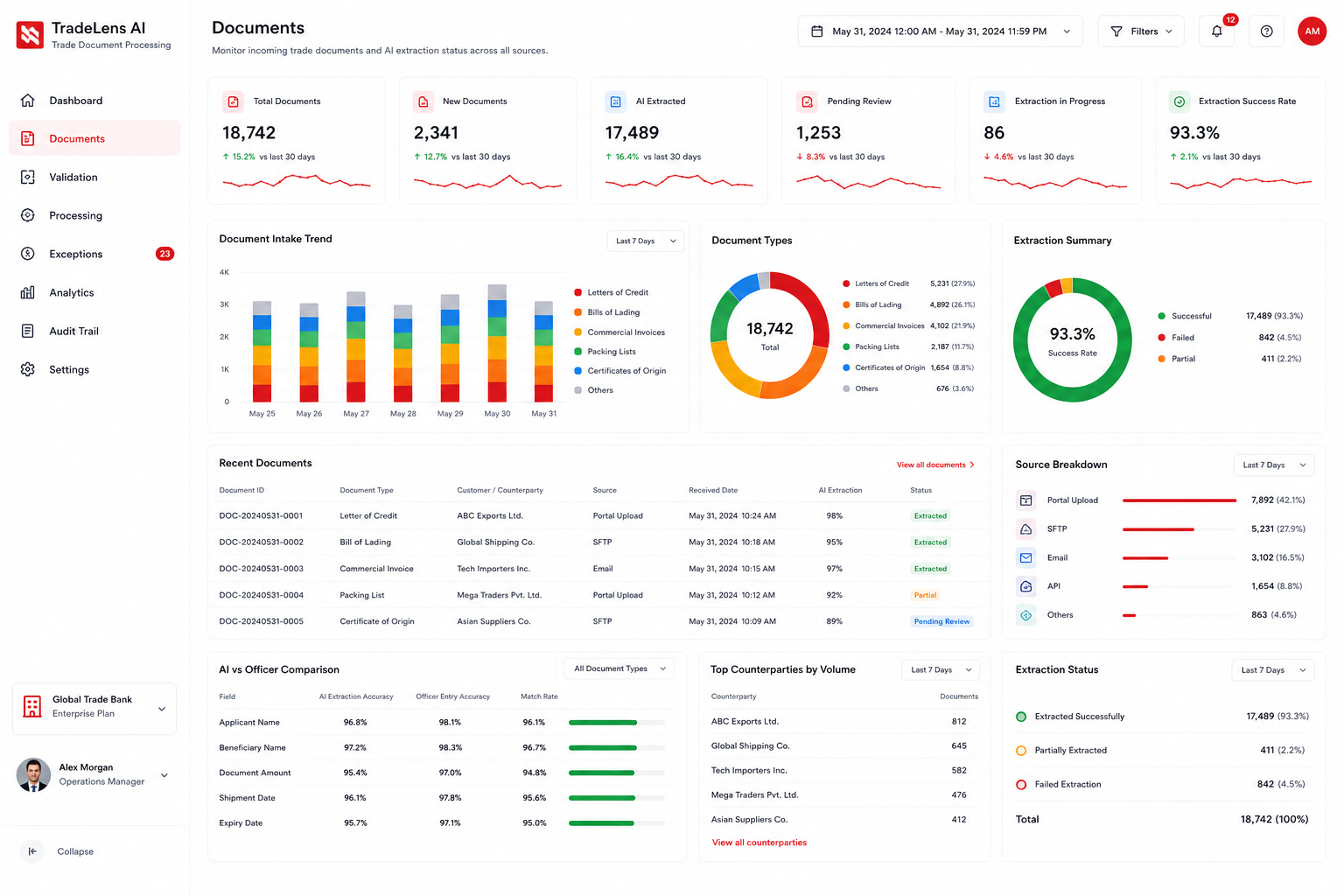
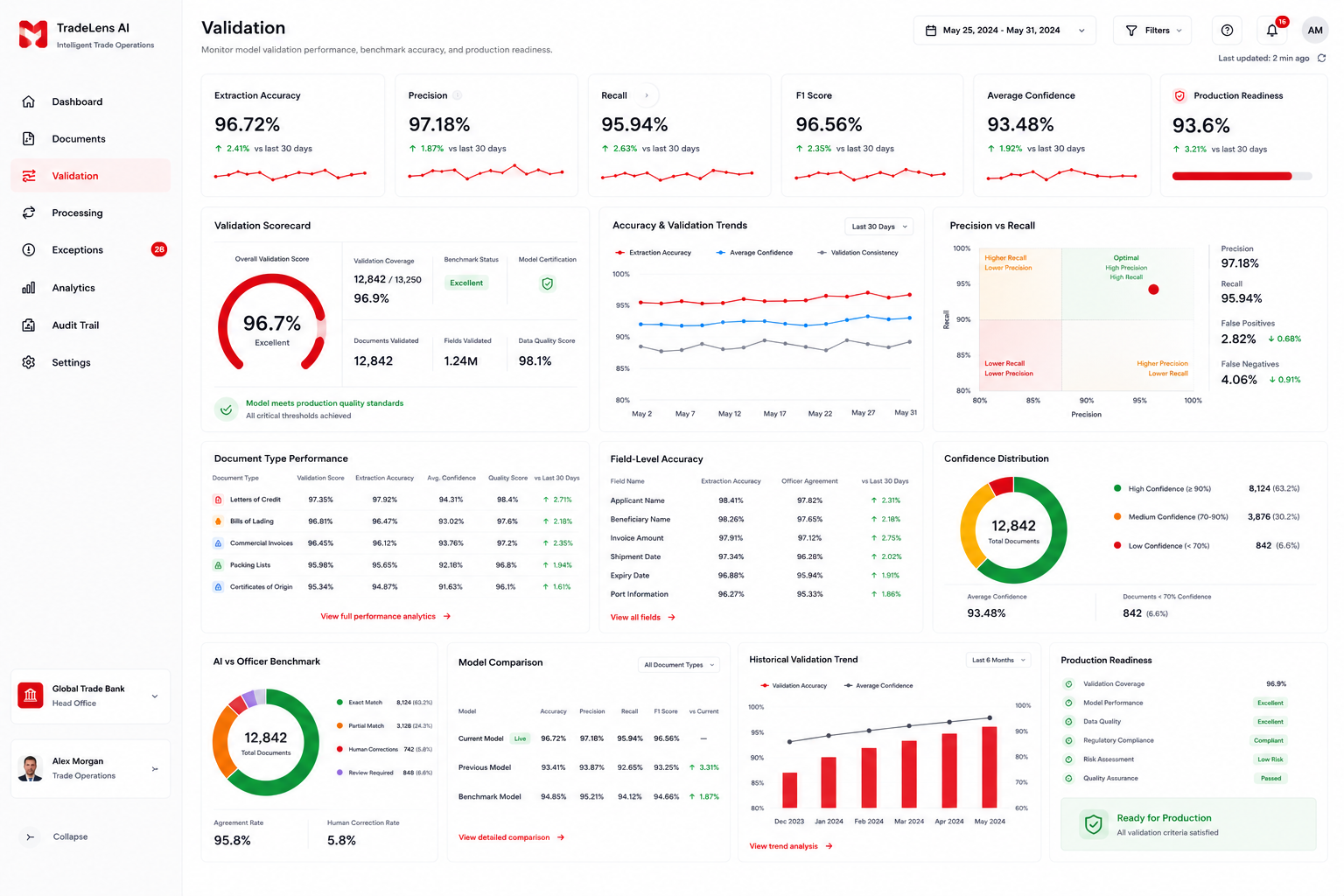
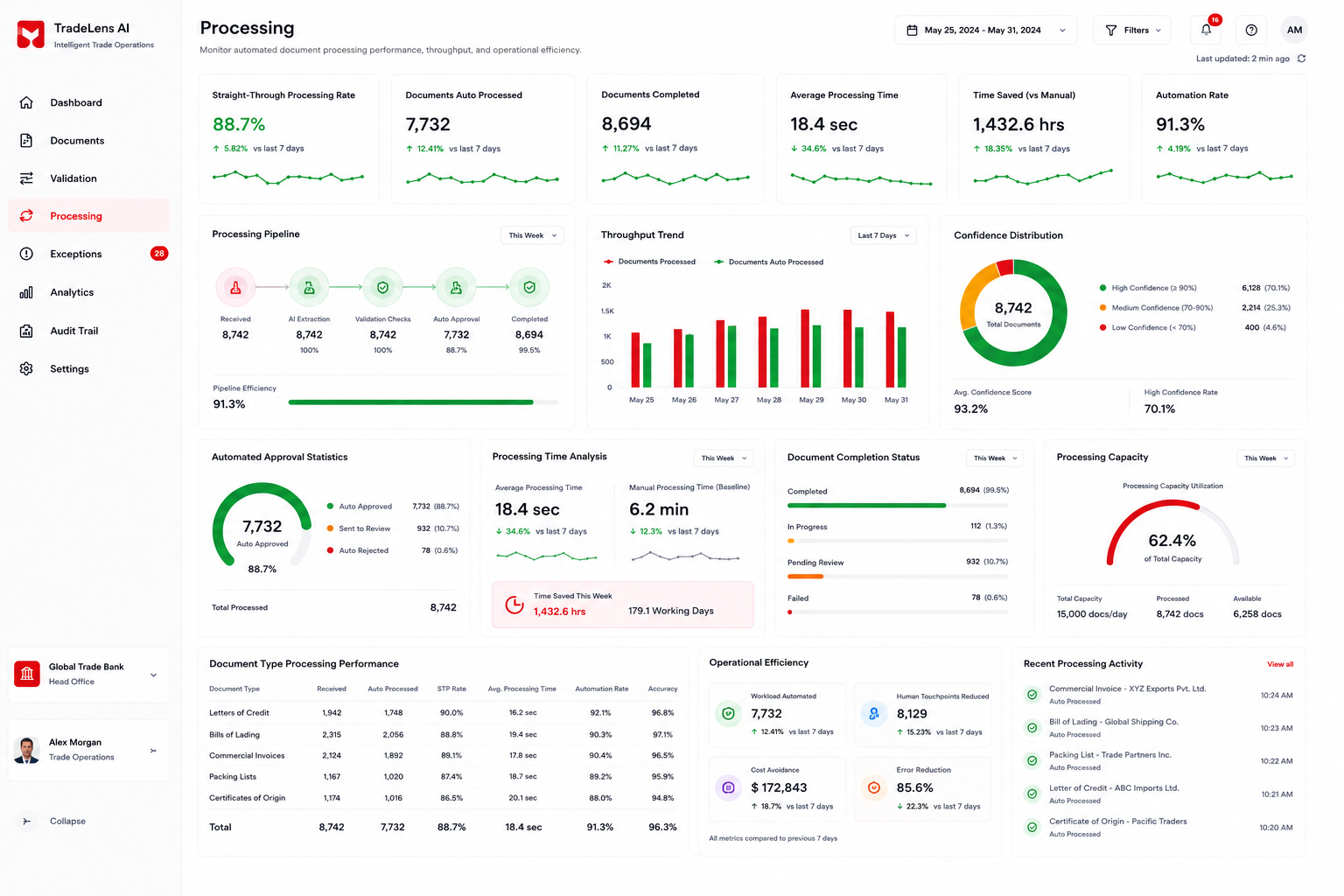
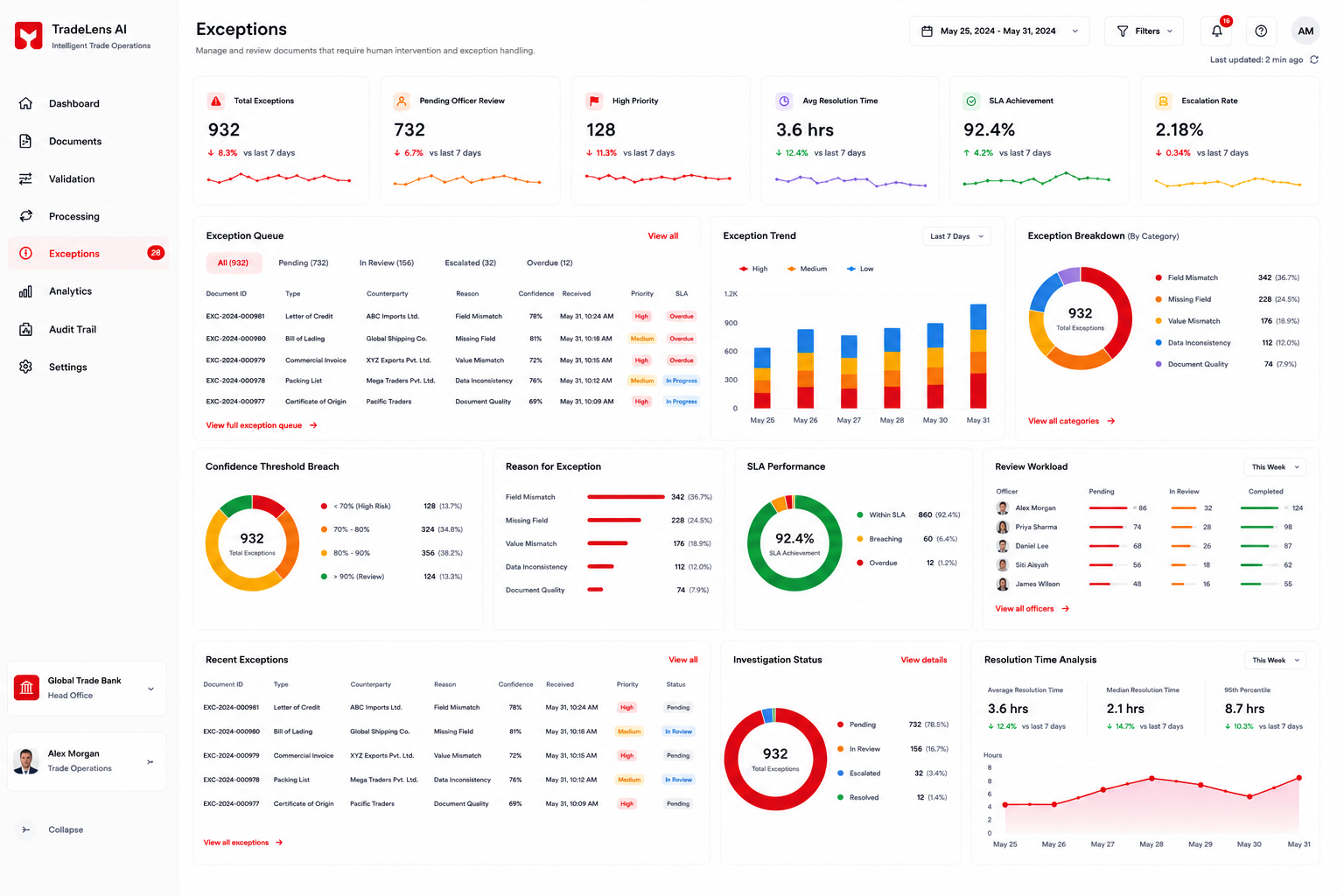
Runs on secure AWS cloud infrastructure with dedicated processing power, document reading (Amazon Textract), and built-in explainability so every decision has a clear reasoning trail. Banking-grade. 99.9% uptime.
What your team actually sees.
Live dashboard, document queue, extraction confidence, and cross-check results in one view.
What the system
actually delivers.
-
75% TAT reduction
Document turnaround time drops by three quarters, accelerating trade financing cycles.
-
Zero data entry errors
The system cross-checks Letters of Credit, invoices, and shipping documents catching mismatches before they become liabilities.
-
100% digital transparency
Full reasoning reports for every extraction create a traceable digital audit trail for internal review and regulatory oversight.
-
10x throughput
Scale trade operations without scaling headcount. The system absorbs volume spikes automatically.
Questions about trade document processing
Common questions from trade finance, operations, risk, compliance, and technology teams evaluating document automation.
What is trade document processing?
Trade document processing is the extraction, validation, and cross-checking of information contained in documents used in trade transactions. This can include Letters of Credit, Bills of Lading, commercial invoices, and other supporting documents. Automation can reduce the amount of manual data entry and help trade officers identify mismatches that require review.
Who is this trade document processing system for?
ICS Compute Trade Documents Processing is designed for banks, financial institutions, and trade finance teams that handle large volumes of trade documentation. It is particularly relevant for operations teams that need to reduce manual document checking while maintaining human review, traceability, and control over exceptions.
What types of trade documents can the system process?
The system is designed to process trade documents such as Letters of Credit, Bills of Lading, commercial invoices, and related supporting documents. The exact document types and fields processed can be configured based on the institution's trade finance workflow and document requirements.
How does the system cross-check trade documents?
The system extracts relevant fields from each document and compares related information across the document set. For example, information contained in a Letter of Credit can be checked against corresponding details in an invoice or Bill of Lading. Potential mismatches are surfaced for further review rather than requiring officers to manually compare every field.
What happens when the system is not confident about a document?
Documents or extracted fields that do not meet the required confidence threshold can be routed to a trade officer for review. This allows higher-confidence cases to move through the workflow while uncertain results remain subject to human verification.
Can the system integrate with existing core banking systems?
Yes. The system can be connected to existing trade finance and core banking environments, depending on the institution's architecture, APIs, security requirements, and workflow. Integration is evaluated during the implementation process before automatic processing is introduced into live operations.
How is accuracy tested before live deployment?
ICS Compute uses a Shadow Sandbox approach in which the system operates alongside trade officers without affecting live operations. Document extraction and cross-checking results are compared with human-reviewed outcomes so accuracy, confidence thresholds, and exception handling can be evaluated before moving to higher levels of automation.
Does the system provide an audit trail?
Yes. The system maintains a record of document extraction results, cross-checks, confidence levels, and processing decisions. This provides trade, risk, compliance, and internal audit teams with greater visibility into how individual documents were processed and why cases were accepted or escalated.
Unify your
trade intelligence.
Four weeks of Shadow Sandbox testing. The system runs alongside your officers, learning your specific trade document types, with zero risk to core banking systems. Once it reaches 95%+ accuracy, we move to automatic processing.
Shadow Sandbox assessment
The system learns alongside your trade officers. Every result is human-verified. Tested against 1,000+ real documents.