Agent or Workflow? The Enterprise AI Diagnosis That Determines What Actually Works
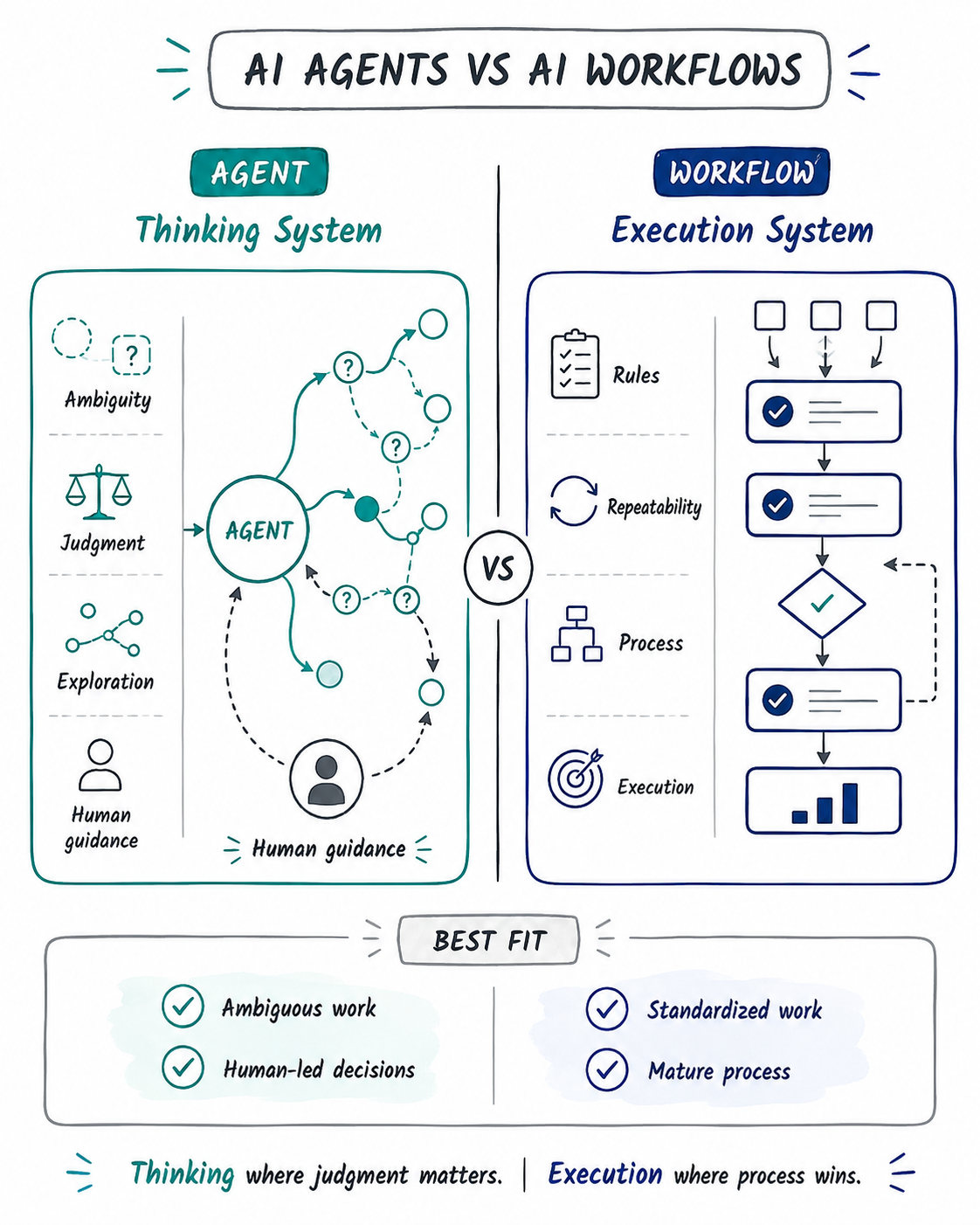
Most enterprise AI programs do not stop because of model quality, infrastructure, or budget. They stop because of a diagnostic error made long before anything is built: the organization confuses the kind of problem it is solving with the kind of system that should solve it. Over the past two years, the language of "AI agents" has moved to the center of nearly every vendor pitch and board discussion. Agents are described as autonomous, adaptive, and capable of reasoning through open-ended problems, and the appeal is easy to understand. An agent promises something closer to a capable colleague than to a piece of software, and that is a far more compelling thing to fund.
The difficulty appears when these programs move from the slide deck into production. The systems that actually ship, run reliably, and earn a permanent line in the operating budget are frequently not agents at all. They are workflows: structured, rules-based automations that take a defined input and return a predictable output. A meaningful share of enterprise AI value is lost in the gap between what gets pitched and what gets deployed, and closing that gap begins with a sharper diagnosis of the work itself.
What an Agent Actually Is, in Enterprise Terms
An agent is best understood as a system designed to operate inside ambiguity. It suits work where the path to the answer is not known in advance, where the relevant information is scattered across systems and documents, and where a person needs to stay in the loop to direct the effort, question the reasoning, and judge what comes back. An agent explores, proposes, reasons across sources, and adapts when the human pushes back. The value it creates lives in the dialogue between the system and a capable user, not in a single output handed over and accepted at face value.
Strategic account planning is a useful illustration. A senior account director working through a complex enterprise relationship is not looking for a templated answer. They are assembling a point of view from fragmented signals, including buying history, organizational changes, competitive movements, and unstructured notes from past conversations. An agent that can gather those signals, propose where the relationship is heading, and surface the assumptions worth testing becomes genuinely useful, because the person remains in command of the judgment while the system carries the cognitive load of exploration.
What a Workflow Actually Is, in Enterprise Terms
A workflow is a system designed to operate inside certainty. The steps are known, the rules are explicit, the inputs are well-defined, and the desired output is the same every time. Work of this kind does not benefit from a system that reasons or improvises. It benefits from rules applied consistently, quickly, and at scale, with a clean audit trail behind every decision. The person involved supplies the input or handles the genuine exception, and the system does the rest.
Invoice matching sits squarely in this category. Reconciling a purchase order, a goods receipt, and a supplier invoice follows a defined logic, and the goal is identical on every transaction: confirm that the three documents agree, flag the cases that do not, and pass the clean ones through without human attention. Introducing open-ended reasoning here would add cost and unpredictability to a process whose entire value comes from doing the same correct thing every time.
Where Implementation Goes Wrong
The failures tend to be symmetrical. The first is applying a workflow to work that genuinely requires judgment. Consider supply chain disruption response. When a port closes, a key supplier fails, or a shipment is impounded, the situation rarely matches a predefined template. A rigid workflow built for this either produces a confidently wrong recommendation or escalates almost every case back to a human, which defeats the reason it was built. People quietly stop trusting it and route around it, and the investment becomes shelfware.
The second failure is building an agent for work that is fundamentally standardized. An "agent" for IT ticket routing or first-pass insurance claim triage, where the overwhelming majority of cases follow clear rules, is an expensive way to introduce variability into a process whose value depends on consistency. The organization pays for reasoning it does not need and inherits unpredictability it cannot afford, while governance and measurement become harder than they were before.
A subtler version of this mistake is commercial rather than technical. Agents sell well because they are exciting, while workflows deploy well because they are governable and measurable. Some programs respond to that tension by branding a workflow as an agent to preserve the narrative for sponsors and stakeholders. The naming confusion then flows downstream into how the system is scoped, measured, and judged, and a perfectly good workflow ends up assessed against expectations that were never appropriate for it.
Why Agents Require Trained Users
An agent's output is only as good as the judgment of the person directing it. It produces drafts, hypotheses, and options rather than verdicts, and extracting value from it depends on a user who knows how to frame the problem, supply the right context, challenge weak reasoning, and recognize when an answer is fluent but wrong. A trained user treats the agent as a thinking partner and remains accountable for the decision. An untrained user accepts the first confident response and inherits whatever errors it contains.
This is why agent value is bounded by user capability, and why deploying agents is an organizational investment rather than a licensing decision. Procurement negotiation preparation makes the point clearly. An agent that surfaces a supplier's cost structure, dependency points, and likely concessions is a powerful asset in the hands of an experienced negotiator who can interrogate the analysis. The same agent becomes a liability for someone who treats its output as a script to be read aloud across the table.
Why Workflows Require Mature Processes
A workflow can only automate a process that the organization already understands. When the underlying rules are inconsistent, undocumented, or riddled with undeclared exceptions, automation simply makes the existing mess run faster and at greater scale. The demanding work sits upstream of the technology: defining the rules, agreeing on how exceptions are handled, cleaning the data the rules depend on, and establishing the controls that keep the system trustworthy.
Vendor onboarding and compliance document checks expose this quickly. If different business units apply different standards to the same document type, or if the "rules" live mostly in the heads of a few experienced staff, there is no stable logic to encode. The process has to be matured before it can be automated, and organizations that skip this step tend to discover that their workflow is only as reliable as the least disciplined corner of the operation it was modeled on.
Reading Real Use Cases More Carefully
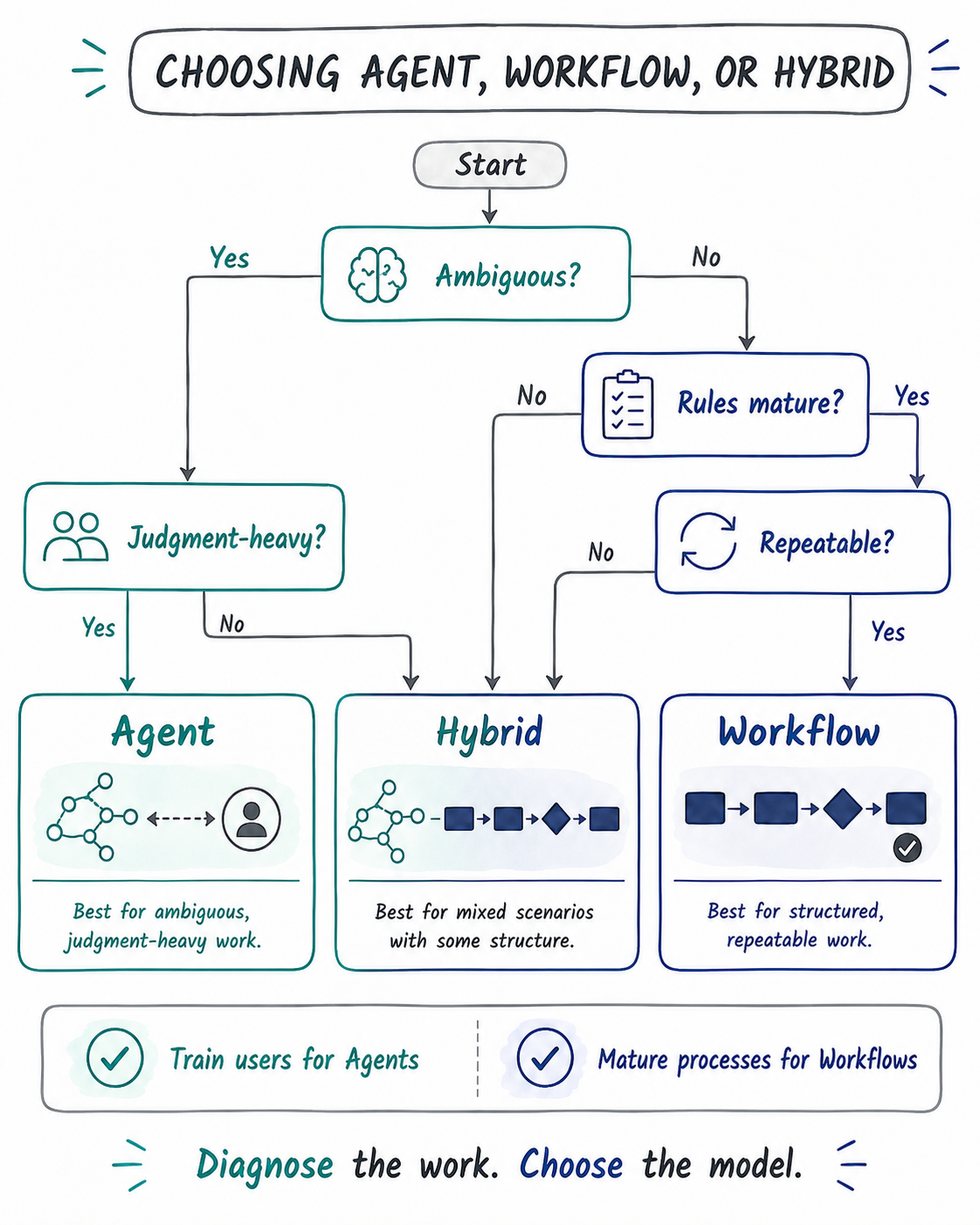
The most practical insight for leaders is that a single business domain usually contains both kinds of work, and the design decision is made at the level of the specific task rather than the function. Legal contract review is a clear example. Checking standard clauses against an approved playbook is highly standardized and belongs in a workflow, while shaping the negotiation strategy for a complex, bespoke agreement is judgment-heavy and benefits from an agent working alongside experienced counsel.
Customer churn intervention follows the same logic. Scoring accounts by risk and triggering a defined retention motion is a workflow problem with clear inputs and outputs. Deciding how to save a major, strategically important account that is showing early signs of leaving is an agent problem, because it requires weighing relationship history, commercial trade-offs, and competitive context that no fixed rule can capture. Enterprise sales forecasting, workforce planning, loan application intake, and claim triage each split along the same line: the predictable, high-volume core is workflow territory, and the ambiguous, high-stakes edges are where an agent earns its cost.
A Simple Diagnostic for Leaders
Before committing budget to any AI system, a leadership team can usually reach the right design decision by working through five questions:
- Is the path to the answer known in advance? A known path points to a workflow; an unknown one points to an agent.
- Does the work need human judgment at the point of decision, or only at the point of exception? Judgment at every decision suggests an agent; judgment only on exceptions suggests a workflow.
- Is the underlying process documented and stable enough to express as explicit rules? If not, the immediate work is process maturity, regardless of the technology chosen.
- Do we have users capable of directing and evaluating the system's reasoning? Agents without trained users do not produce reliable value.
- Which is more costly here: an inconsistent output, or a rigid one? This single trade-off often settles the question on its own.
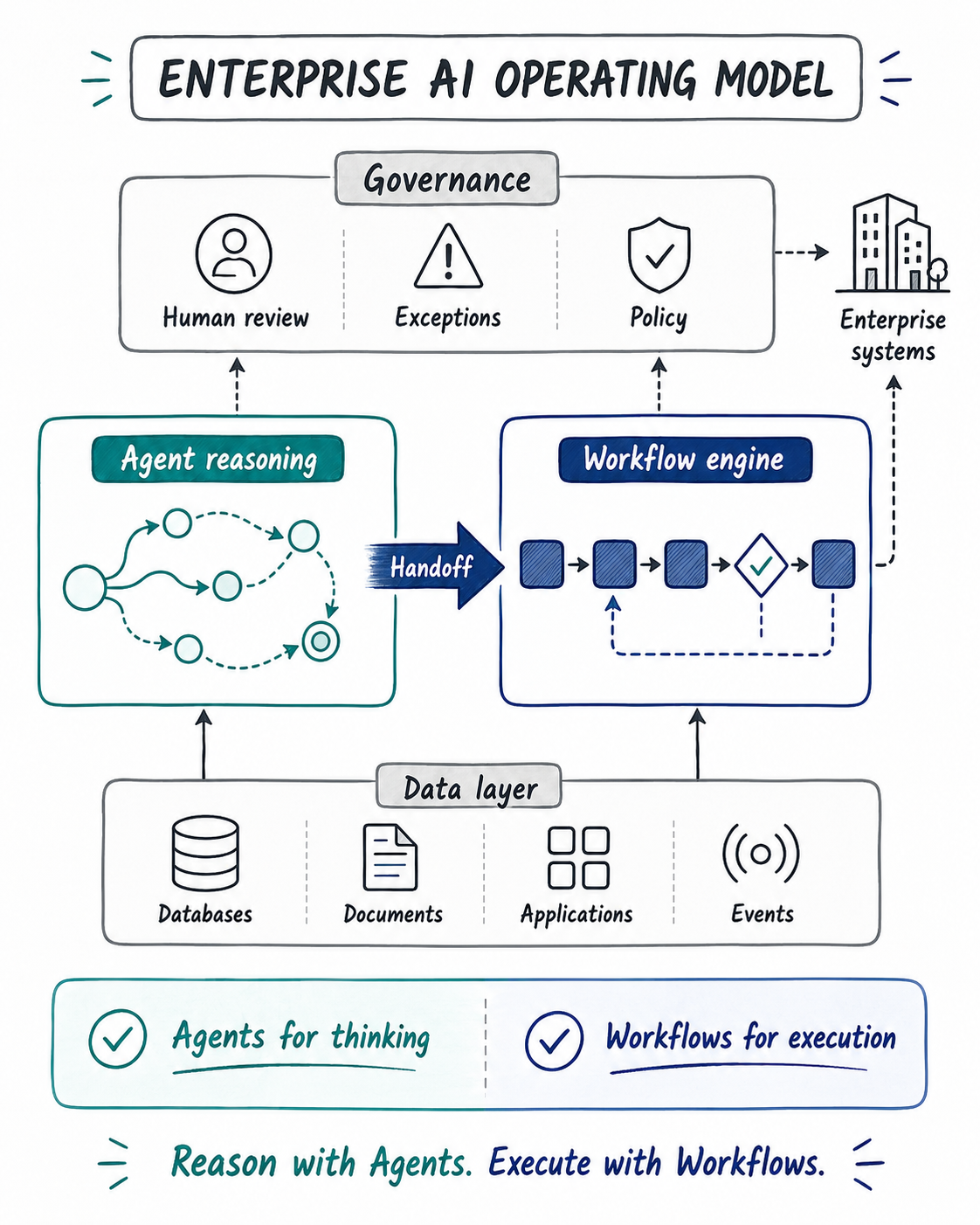
The answers rarely point exclusively to one model across an entire function, which is the point. A well-designed AI estate combines both: an execution layer of workflows that handles the predictable, high-volume work, and a thinking-partner layer of agents that supports the judgment-heavy decisions where value and risk concentrate.
Designing the Right Operating Model
The choice between an agent and a workflow is an operating-model decision rather than a technology selection, and treating it that way changes how programs are scoped from the outset. Organizations that succeed begin by diagnosing the work, separating the standardized core that should be automated from the ambiguous decisions that deserve a capable partner, and only then deciding what to build. The technology question becomes straightforward once the diagnosis is honest.
For companies across Southeast Asia investing seriously in AI, this discipline matters more than the choice of any particular model or platform. The systems that survive contact with daily operations are the ones matched correctly to the nature of the work, governed in proportion to their risk, and supported by either the trained users or the mature processes they depend on. The competitive advantage will not belong to the companies that deploy the most agents. It will belong to the ones that knew which problems needed an agent at all.